USD
USD

Do you want to turn your design ideas into real products, but feel stuck because of high minimum order quantities or inventory risks? Many designers and small brands face the same problem. Traditional manufacturing often requires bulk production, which means higher costs and more pressure.
This is where print on demand can help. Print on demand allows you to create custom products only when you needed them. You don’t have to produce in large quantities or hold inventory. In this guide, you’ll learn what print on demand is, how it works, and how to start your own small business.
What Is Print on Demand (POD)?
Print on demand (POD) is a business model where products are printed and fulfilled only after an order is placed. Instead of producing items in bulk, each product is created based on actual demand. This reduces waste and eliminates the need for inventory. The seller focuses on creating designs and offering products, while the supplier takes care of printing, packaging, and shipping.How Does Print on Demand Work?
How on-demand printing works depends on your business model. For designers and brands, there are 2 common approaches.
1. On-Demand Production (Small Batch or Sampling)
In this model, you create your design and send it to the provider. The supplier produces the items based on your request. Once the products are ready, they are shipped to you. You can then sell them to your customers. This approach is useful if you want to:Test new ideas / Create samples / Launch small collections.2. Pre-Order or Made-to-Order Model
This model starts with your customers. You first show your design to your audience. Then you collect orders within a limited time. After that, you confirm the total quantity and send the order to your supplier. The supplier produces exactly what has been ordered. This means no unsold stock. This approach works well for: New product launches / Limited editions / Small stores or brands.Once the order details are confirmed, the production process begins.
Printing and Manufacturing
The supplier prints your designs on any product you select, from fabrics and clothing to home goods and accessories. The exact printing method depends on the product type and material. Digital fabric printing is often used because it supports detailed designs and flexible production quantities.Packaging and Delivery
Once production is complete, the finished products will be packaged and ready for shipment. There are 2 common delivery options, depending on your business model:1. Ship to You
The products will be delivered directly to you, and you can handle packaging, brand promotion, and final shipping yourself. This option gives you full control over how your products are presented and shipped to your customers.2. Ship Directly to Your Customers
You can also choose to have the supplier ship the products directly to your customers. This can reduce processing time and simplify logistics, especially for online businesses.Both of these options are available on customprintingfabric.com. You can choose the approach that best fits your workflow, whether you prefer full control over branding or a more streamlined fulfillment process.
Popular Print on Demand Products
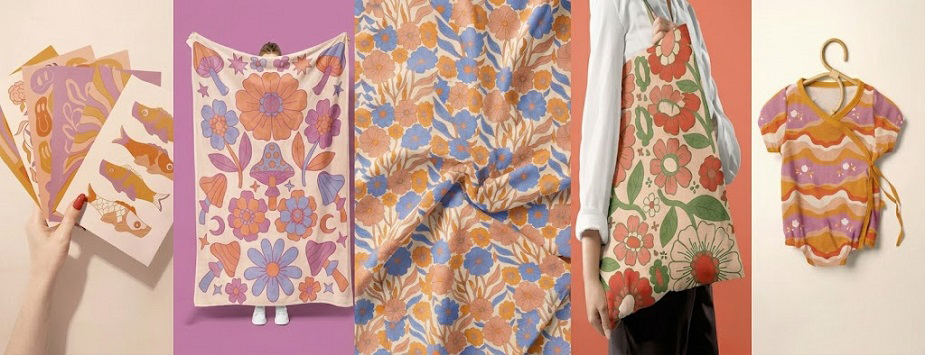
Print on demand gives you the flexibility to expand your designs into multiple product categories. Instead of focusing on a single item, you can create a complete product line, from custom fabrics to apparel and home textiles, based on your brand or creative concept. Here are some popular print on demand products you can create:1. Custom Printed Fabrics
Custom printed fabrics are indeed a foundational, flexible, and powerful application within the print-on-demand (POD) landscape. Instead of choosing ready-made patterns, you can print your design directly onto fabric and use it for your own products. With this approach, designers and brands can develop unique fabrics for clothing, home decor, accessories, and more. Whether you are testing a new idea or producing a small batch, custom fabric printing makes it easier to bring original designs to life without committing to large production quantities.2. Custom T-Shirt Printing
T-shirts are easy to design and quick to produce, which makes them a common choice for many types of projects. A simple graphic, logo, or text can be applied without much adjustment, so the process stays straightforward. With print-on-demand, designs can be updated quickly, making it easier to try new ideas or release different versions without slowing down production.3. Custom Flannel Blankets
Flannel blankets are soft and comfortable. They are often used as gifts or for home use, especially during colder seasons. A blanket gives you a large, uninterrupted surface, so patterns, photos, or illustrations can be printed across the entire piece. This is the perfect choice for launching seasonal new products or special collections in your on-demand printing segment.4. Custom Cushions & Pillows
Cushions and pillows are often used to add color and detail to a space. Even small changes in pattern or texture can make a room feel different. Designs are usually printed on one side, but double-sided printing is also possible depending on the product. With print on demand, it’s easier to experiment with different looks or create matching sets.5. Custom Tablecloths & Table Covers
Tablecloths and table covers are often used for dining, events, or display setups where the overall look needs to feel consistent. The design usually follows a theme, whether it’s for a season, a brand, or a specific occasion. The same design can be applied to different sizes or formats, which makes it easier to build a small collection. This approach also works well for short-term use, such as event-specific designs or limited runs. With print on demand, these variations don’t require advance preparation. Different styles or quantities can be offered as needed, which makes it easier to try new ideas without holding extra stock.Pros and Cons of Print on Demand
Pros of Print on Demand
- No need to hold inventory or produce in advance, which allows you to launch products without upfront stock risk.
- Designs can be applied across different product types such as fabric, clothing, and home items, making it easier to expand a product range.
- You can test new ideas or collections in small quantities before committing to larger production.
- Products are made based on actual orders, which helps reduce the risk of unsold stock.
Cons of Print on Demand
- Production time is longer since each item is made after an order is placed, which can affect delivery speed.
- Unit cost is generally higher compared to bulk manufacturing, which limits pricing flexibility in low-margin markets.
- Less control over mass production efficiency, which may not suit businesses that rely on high-volume, fast turnover.
Common On-Demand Printing Methods
1. Direct-to-Garment (DTG) Printing
DTG printing is one of the most popular methods for t-shirt printing and other cotton-based garments. It works like an oversized inkjet printer, spraying water-based ink directly onto the fabric.
Advantages: Excellent for detailed designs, gradients, and full-color images with soft hand-feel.
Limitations: Higher per-unit cost and best suited for cotton or cotton-blend fabrics. It is ideal for small-batch custom apparel but less efficient for very large runs.
2. Sublimation Printing
Sublimation printing excels on polyester fabrics and blends. The process uses heat to turn solid ink into gas that permanently bonds with the fibers.
Key strengths: Extremely vibrant colors, smooth gradients, and full-bleed coverage that won’t crack or peel. It is perfect for sportswear, fashion apparel, and all-over-print designs.
Note: It performs best on light-colored polyester substrates.
3. Screen Printing
4. Digital Fabric Printing
Digital fabric printing has become the backbone of modern on-demand textile production. Using advanced digital printers, it applies ink directly onto rolls of fabric before the garment is cut and sewn.
This method stands out because it:
- Supports highly complex, multi-color, and intricate designs with photographic quality
- Enables true small-batch and even one-piece customization without high setup costs
- Works across a wide range of materials for both clothing (dresses, shirts, activewear) and home textiles (curtains, cushions, bedding)
Compared with older methods, digital fabric printing offers greater design freedom and faster turnaround, making it especially suitable for fashion-forward brands, artistic prints, and personalized home décor. It combines high quality with the flexibility that POD business models demand. By choosing the appropriate printing technology for each product, POD services can deliver excellent visual results while keeping costs efficient and production scalable.
How to Start a Print on Demand Business?
Starting a print on demand business usually begins with choosing what you want to sell and how you want your products to be produced. Most sellers start by focusing on a specific product category, such as apparel, fabrics, or home textiles.
The next step is creating or preparing your designs. Since products are only made after an order is placed, the focus is more on creating designs that can work across different products or collections. After that, you work with a print provider to produce and fulfill orders. Depending on your setup, products can be shipped to you for further handling, or sent directly to your customers once they are produced.
Once the system is in place, the focus shifts to testing. Many sellers start with a small number of designs, observe customer response, and gradually expand into new product types or collections based on demand.
Best Print on Demand Platforms
Choosing from different print on demand platforms depends on what products you want to sell, how you plan to manage production, and how much control you need over fulfillment and quality.
There is no single platform that fits every business. Instead, different print on demand websites focus on different strengths, such as apparel production, custom fabrics, home products, or integration with online stores.
Some platforms are designed for easy store integration and automated order fulfillment, making them suitable for sellers who want a simple setup. Others focus more on production quality, material options, or custom manufacturing capabilities, which is more important for brands working with textiles or unique product categories.
When comparing print on demand platforms, it is more useful to look at product range, print quality, production flexibility, and scalability rather than relying on popularity alone. The right choice usually depends on whether you are testing designs, building a niche brand, or scaling a product line.
What Makes CustomPrintingFabric's Print on Demand Services Stand Out?
CustomPrintingFabric is a professional print on demand provider specializing in custom fabric and finished textile products. We offer a wide range of products, including T-shirts, hoodies, dresses, blankets, tablecloths, curtains, cushions, bedding, and fabric by the meter. All items are available for small batch production and even single-piece orders.
Our production is based on advanced digital fabric printing technology. This technology can print patterns directly onto rolls of fabric with accurate colors, rich details, and strong washability. It is especially useful when you need to test ideas, produce small batches of products, or build a new brand without ordering in large quantities. With so many print on demand providers, CustomPrintingFabric can help you turn your ideas into reality.